We ship orders the same or next day. DPD delivery: 2–7 days, free from €100. We ship orders the same or next day. DPD delivery: 2–7 days, free from €100. We ship orders the same or next day. DPD delivery: 2–7 days, free from €100.
We ship orders the same or next day. DPD delivery: 2–7 days, free from €100. We ship orders the same or next day. DPD delivery: 2–7 days, free from €100. We ship orders the same or next day. DPD delivery: 2–7 days, free from €100.
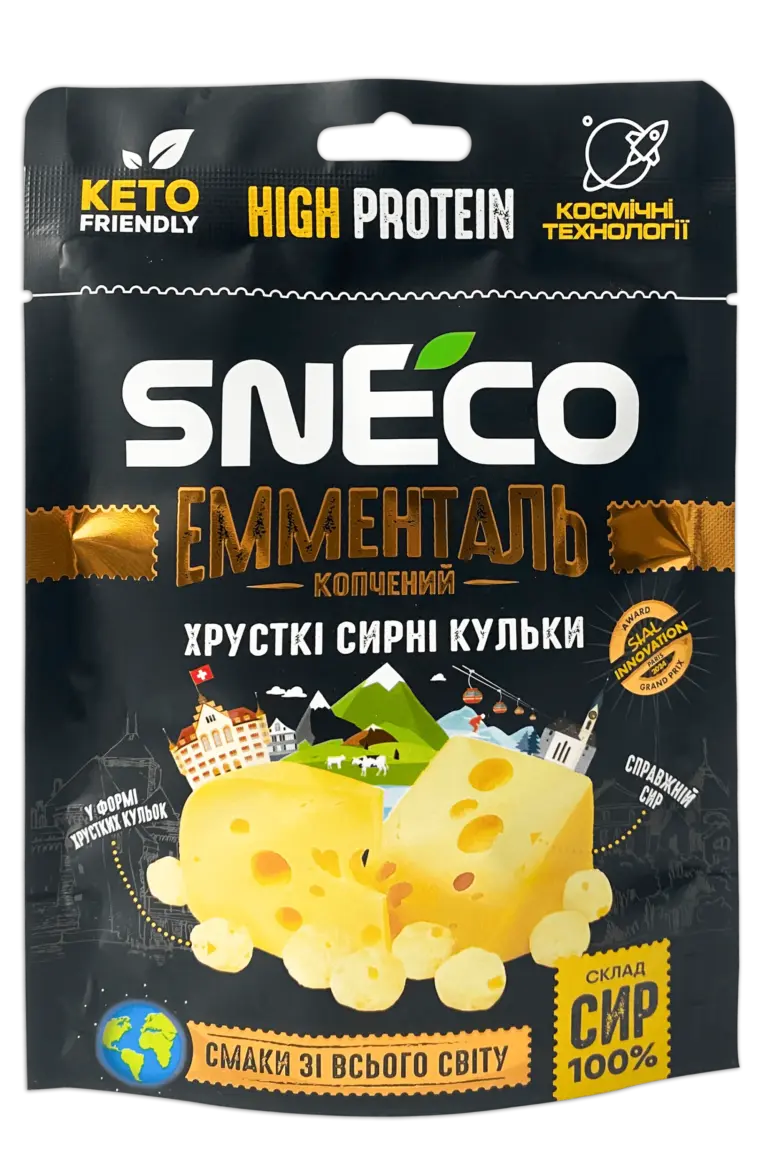
Short answer: Emmental is a Swiss hard cheese from the Emme river valley, the very “cheese with holes” from cartoons. The taste is mild, sweetish and nutty; aged, it gets spicier. The holes are made by bacteria that release carbon dioxide during ripening. It is eaten with bread and wine, in fondue and hot sandwiches; snEco smoked Emmental in dried form is crispy bites with a hint of smoke and 46 g of protein per 100 g.
The cheese has been made in the canton of Bern since at least the 13th century, and the wheels are huge, 75–120 kg each. The holes (cheesemakers call them “eyes”) are the work of propionic acid bacteria: while ripening at 20–24 °C, they convert lactic acid into propionic and acetic acid, releasing CO₂. The gas cannot escape through the dense rind and collects in bubbles. The same bacteria give Emmental its recognisable sweetish, nutty taste. The larger and fewer the holes, the better the cheese has ripened.
| How | Why it works |
|---|---|
| Fondue | a classic with Gruyère: Emmental melts evenly and stretches |
| Hot sandwiches, croque-monsieur | that same stretchy “cheesy” layer |
| With white wine | Chasselas, Riesling, Chardonnay — a sweetish cheese meets the acidity of the wine |
| With beer | smoked — with bock and dark lager; young — with wheat beer |
| With whisky | smoked Emmental is milder than Sulguni — for Speyside and mild Scotches. Whisky snacks |
| Cheese board | as a “semi-hard cheese with character” between Gouda and Primaggio. How to build one |
Fresh Emmental: about 28 g of protein, 29 g of fat, 380 kcal per 100 g — one of the most protein-rich popular cheeses, and practically lactose-free. snEco dried smoked Emmental: 46 g of protein, 44 g of fat, 1.6 g of carbohydrates, 660 kcal and 3 g of salt per 100 g. A 28 g pack has 12.9 g of protein, 185 kcal. Ingredients: cheese (pasteurised cow’s milk, salt, starter culture, enzyme). Comparison with other cheeses — how much protein is in cheese.
The snEco range has two smoked flavours. Sulguni is salty and sharp, a “beer” cheese. Emmental is milder: the nutty sweetness of the cheese plus a hint of smoke, without too much salt (3 g vs 6 g per 100 g). That is why it is chosen by those who find Sulguni too salty but still want a smoky flavour with wine, whisky or just coffee. Its crispy bites have a distinctive smoky note in the aftertaste rather than on the nose.
28 g pack, 500 g pack, box of 15 packs. Other flavours — range guide; how it differs from Sulguni — see the article Smoked Sulguni.
Author: Pylyp Gryshyn, co-founder of snEco, head of production
Share on:


We’ll call you back and help!

 Dried snEco Cheese “Emmental”, 28 g
 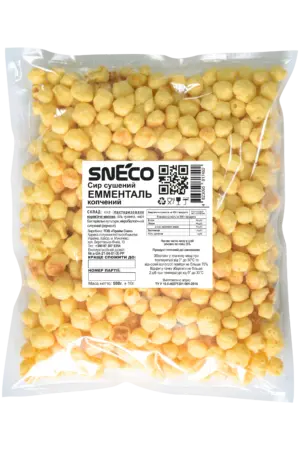 Dried snEco Cheese “Emmental”, 500 g
  Dried snEco Cheese “Sulguni”, 28 g